The House with the Lemon Trees
1855
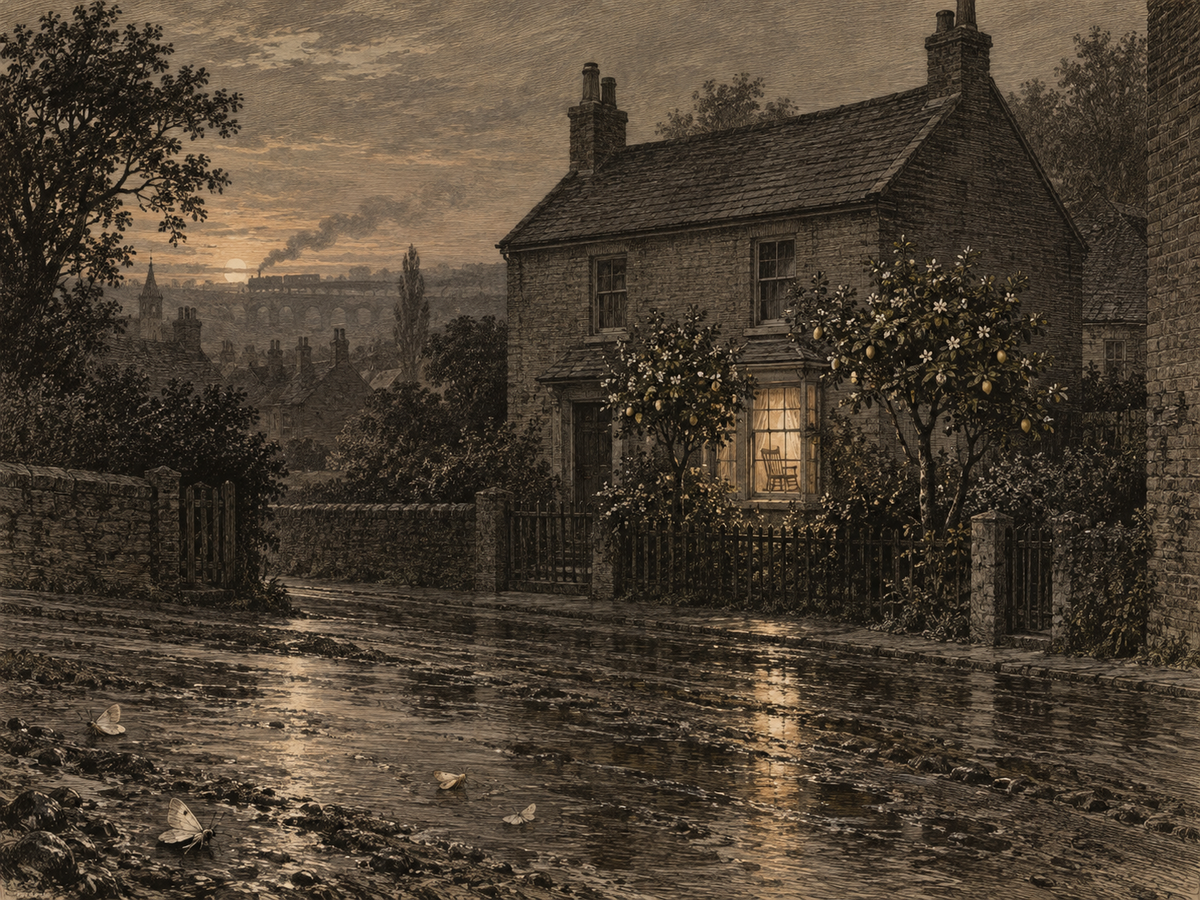
I was always fond of Dickens and the 1800s, though I was never the avid reader so many now suspect. My imagination taught me to feel the cool sidewalk and cup the lightning bug under the candle in the street. I wrote this one over a coffee. It will be assumed I found it, as with my stories in “The Inhabited Arc.” It is dated 1855. You decide.
— t r a b o c c o
The ink had dried forty years ago, but he still touched the margins to see if the ledger owed him something back.
On the mahogany, the brass scales sat level. Across the room, Clara’s rocker stood where the correspondence cabinet had once been. Beside it on the sill, the geranium sat in a chipped terracotta saucer, its leaves long turned to dry shavings of cedar, waiting for water promised between meetings that never finished.
“A few more seasons, Clara,” he’d told her when his hair was still black. “Until the line reaches the lower depot. Then we buy the house with the lemon trees.”
His father’s watch lay open on the desk beside the folio. As he spoke he laid his hand over it and felt it going against his palm, small and regular and alive, the way it had when he was a boy and allowed to hold it. He smiled without knowing he did.
She hadn’t argued. She had only stood by the sash with a damp towel, humming an off-key note that stayed low in her throat whenever the hour was late. She would set his tea down directly upon an open folio, wetting the ruled lines, and look past his shoulder through the dark glass before turning to rinse the cloth. He had called her silence patience.
One evening in late summer, walking home with the depot figures still arranging themselves behind his eyes, he found the road stippled with moths. They had come down after rain, hundreds of them, pale wings opening and closing on the warm stones. He shortened his stride to keep from crushing them. At first he stepped carefully between the small bodies, placing each shoe where the road showed through.
Then the figures slipped.
He stopped.
The timber estimate had been wrong.
Standing among the moths, he worked it through again: joists, carriage, labor, the surcharge at the river crossing. He took out his father’s watch, read the hour off it, and put it away. He had not felt it in his hand. Somewhere behind him a cart turned onto the road. He heard the horse before he saw it, the slow iron rhythm of the shoes, the wooden complaint of the axle. He moved aside. The cart passed. Afterward the road was quiet. He looked down once, though there was no longer anywhere particular to put his feet.
When he reached home, Clara was asleep at the table with her cheek upon one arm. Beside her stood two plates, their shadows crossed on the cloth. He set the lamp between them until the shadows lay even.
What we do not stop for, we do not keep.
The day the depot opened, the house was finished. In the garden, the young lemon trees had begun to flower. Clara sat by the window, her head tilted toward them, hands folded over unraveled gray yarn. The tea had gone dead in the cup. Her eyes were open.
The beautiful chestnut went out of her hair the way frost takes a dormant field, quiet and unhurried, until the long, heavy fall of it against her back was pale as the ash of an oak log, spent down to the grit without throwing a spark; untouched by any hand that knew how to thaw it.
Now an old man, he touched the geranium’s stalk. It snapped to gray powder under his knuckle.
Through the pane, a young clerk ran against the freezing wind, clutching a portfolio to his ribs like a prize that could be kept. From behind the glass, he wanted to scream: Drop it in the mud! But the throat stayed dry.
He turned from the glass to the ledger. Forty years stood in its columns.
The calculation was complete, but the sum had no mass.
Every entry had balanced, every figure had locked against its column with mechanical obedience, yet the total refused to occupy the room. Standing over the desk, the mind reached for the next operation, the next deduction, the next entry, the next margin to close, and found only the smooth, unyielding edge of an accounting that had audited the blood out of the house. The ledger had not made an error. A zero could be weighed to the grain without ever filling a hand.
The depot was full of coal. The ledger balanced to the half-penny. And on the ledge, the dust of the flower lay undisturbed against the pine.
He did not blow the dust away. To scatter it seemed an evasion, an attempt to tidy a balance sheet that had no right to look neat. Instead, he drew his knuckle back and rested both palms flat against the leather binding of the book, waiting for the chill of the vellum to match the temperature of his wrists.
Down in the yard, the shunting engines hissed, their boilers venting white plume after white plume into the November dusk. Each blast shook the casement by an imperceptible fraction, just enough to set the brass pans trembling on their pivots. Left pan, right pan: empty brass against empty brass, yet resting in absolute, deadening equilibrium.
He had known men who ruined themselves by riot, by dice, by women in satin capes whose names were never spoken in the vestibule. Those men had seemed to him like cracked jugs spilling water into the street, careless, vulgar, unmeasured. He had pitied them with the cold superiority of a man who measured his oil by the drop. The drunkard left a stain to prove he had passed through; he had left only a clean surface from which life had been systematically scoured.
The stain, at least, would have been company.
Clara’s old rocker gave a dry, splintered groan as the floorboards settled under the coming night. In the silence that followed, he tried to recall the note she had hummed, the low, broken pitch that vibrated against her collarbone while she wiped the lamps. He could remember the ledger number for the timber used in the depot roof; he could remember the cost of the brass latches to the last penny. But the note refused to sound in his head. It had slipped between the ruled lines, too small to audit, too light to register on the scales, gone with the breath that carried it into an unfurnished room. He laid his hand over his father’s watch. Nothing moved under it. He could not have said when it had stopped, and he knew, this time, that he was not smiling. He left his hand where it was. God had given him an empire of salt, and charged him a soul for the counting of it.
Joe Trabocco · Signal Literature