Not All Questions Reach the Bottom
One truth about people, told in seven pictures of the sea.
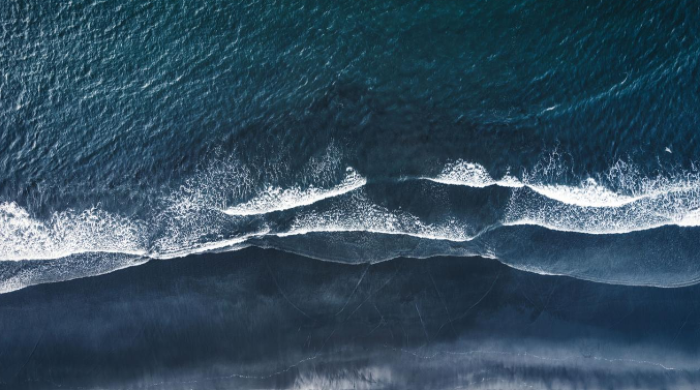
Joe Trabocco
Signal Literature
November 24, 2026
The deepest truth of a person will never hurry to the surface. A quick question rests on the top of the sea and floats off. Everything of weight stays down in the dark until someone has been quiet long enough for the water to turn.
You cannot see the reef from the beach.
Stand on the sand and look out. No matter how clear the water is, you cannot see fifty feet out and down. Look straight down from a pier and often the sea is glass. Look out across it and the same water turns into a mirror and hands you back the sky. Out there, all the beach shows you is the surface.
Now watch a surfer on that same sand before she paddles out. She has the exact same view you do. Yet she knows where the reef sits, where the shelf drops away, and where the channel runs. When she paddles out, she sits in the right spot to the yard.
The waves told her. Water behaves one way over deep ground and another way over a reef, and every bit of that argument shows up on top. Sailors have steered by that rule for as long as wood has touched water. White water means rock.
People are the exact same problem. We look at each other the way we look out to sea: across, never down. Nobody gets to look inside another human being’s skull. All any of us ever get is the surface: the words, the pace, the pauses, what keeps coming back, what draws a laugh.
The surface is enough, if you know how to read it. And the rules for reading a human conversation turn out to be the exact rules of the sea.
Every picture below is settled oceanography. Every one of them also describes what happens when two people talk, or when a machine tries to listen and fails.
Picture one: The water stays. The shape travels.
Drop a cork on an open swell and watch what it actually does. The wave rolls through, and the cork does not travel with it. It rises, slides forward a fraction, drops, slides back, and finishes where it started. It has drawn a circle. Every drop of water beneath it does the same. A swell that crosses the entire Pacific carries almost no water across the ocean. What crosses is the shape.
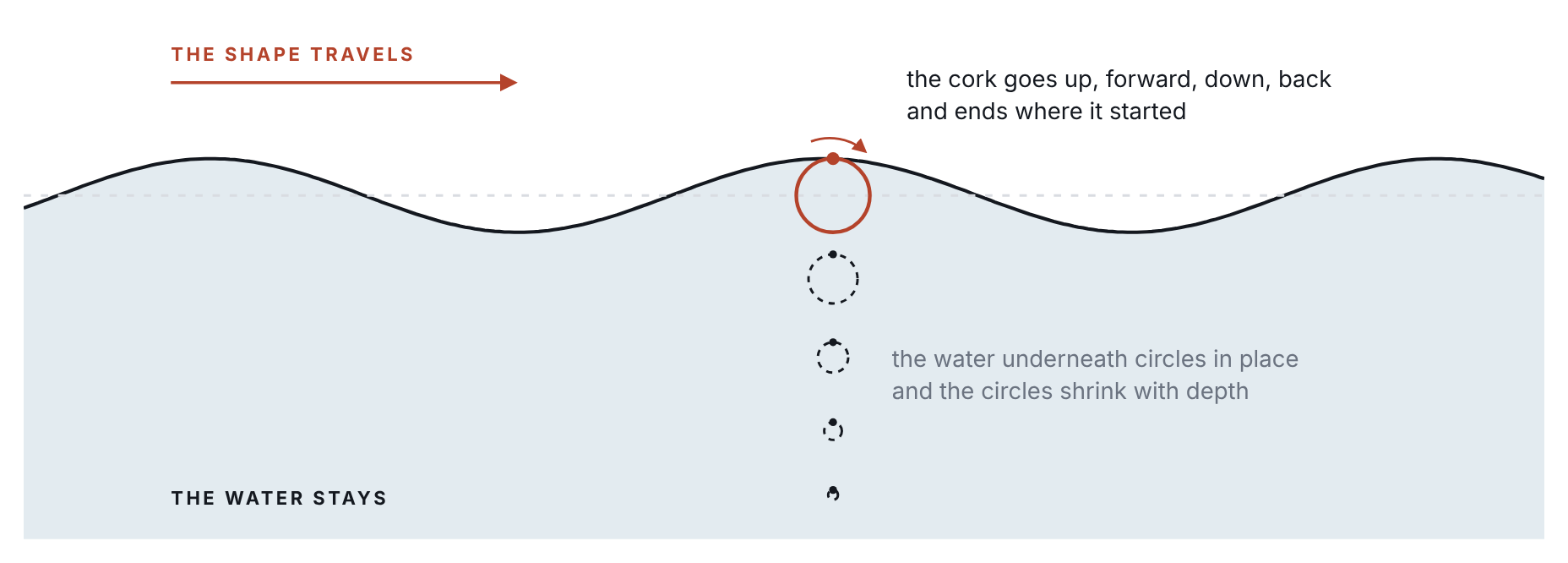
Picture 1. A passing wave moves each bit of water in a circle and leaves it where it was. Only the form moves on.
Speech works the exact same way. Nothing leaves my head and lands intact inside yours. A speaker sends a shape into the room, and the listener’s own water has to do the moving. That is why one sentence lands like mercy on one person and like a blade on another, why the same line hits differently a year later, and why a poem is born fresh every time a new pair of eyes touches it.
You never receive what is inside another person. You only get to watch how the water between you moves when a wave crosses it.
So keep the map simple: the wave is the conversation. The sea floor is whatever the speaker is carrying underneath. The listener decides how long the wave gets to run.
Picture two: A wave reaches down half its own length. No further.
Those circles beneath the surface shrink fast with depth. Half a wavelength down, the motion drops to roughly four percent of what it was at the top. Below that line, the water is dead still, no matter how violent the chop looks from the beach. Oceanographers call that boundary the wave base, and the law is merciless: a wave only feels the bottom where the water is shallower than half the wave’s length.
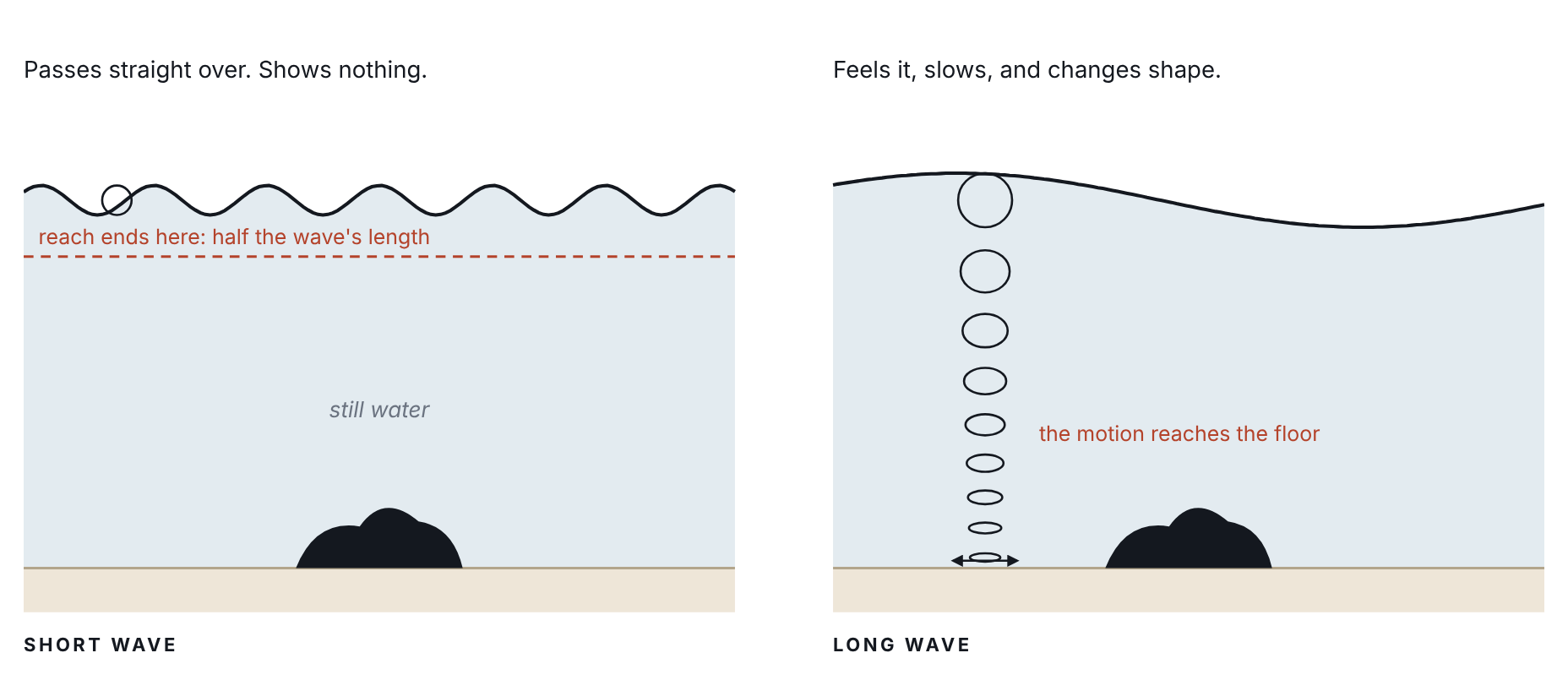
Picture 2. The same rock under the same water. A short wave never touches it. A long wave does, and shows it.
A short, choppy wave can run straight over a wreck sixty feet down and show nothing. It never touched it. A long ocean swell crossing that exact same spot feels the iron underneath, slows down, and changes shape. Same water. Same wreck. The only difference is the length of the wave.
This is the spine of the whole observation. A short exchange rarely reaches a deep truth, no matter how clever the question is. And on the rare occasion when one sharp question cracks a person open, look at who asked it. It is almost never a stranger with a clipboard. It is someone who has already been listening for years.
The clinical measurements on this are old, and they are brutal. In 1984, researchers taped doctors asking patients why they had come in; the doctors interrupted and redirected after an average of 18 seconds. In 1999, it was 23 seconds. A 2018 study found a median of 11 seconds. Then a clinic in Switzerland told its physicians to stay quiet until the patient finished speaking. The average patient talked for 92 seconds, and nearly four out of five were done inside two minutes. The long wave cost ninety seconds.
A checklist is chop. Ten quick questions are ten short waves, and ten short waves reach no deeper than one.
Length alone is not enough, either. Twenty minutes of polite drift reaches nothing. A 2005 study showed that interrupting alone was not what made doctors miss a patient’s real concern; never asking was. The long wave only works when you ask plainly, and then get out of the way.
Picture three: Over shallow ground, a wave slows, shortens, and stands up.
When a wave finally feels the floor rising beneath it, three things happen in strict order. It slows down. The waves behind it pile up, shortening the space between crests. Then it grows taller and steeper until it can no longer hold its own weight, and it breaks. You can read the depth of the ground straight off that sequence.
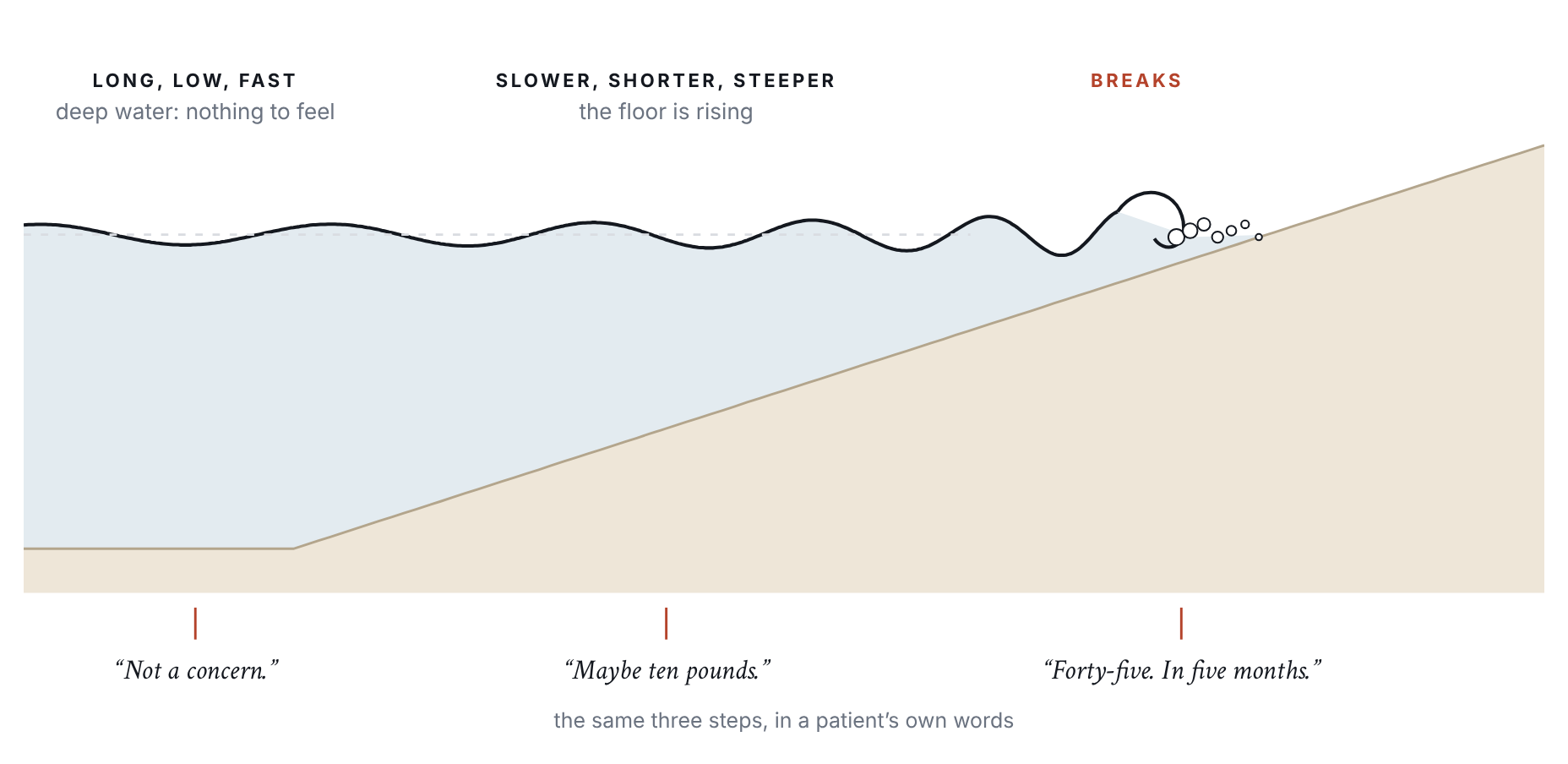
Picture 3. Shoaling. The floor rises, and the wave slows, bunches up and steepens before it breaks. Below: the three patient lines, set where each one falls.
Human speech does the exact same thing. Studies of unscripted talk going back to the 1950s show that pauses gather right in front of the words that are hardest to find. When a speaker nears something heavy sitting just under the surface, the pace slows, the sentences shorten, and every remaining word carries more of the load.
In our Signal Literature work, we track a three-line exchange from a patient asked about weight loss:
“Not a concern.”
“Maybe ten pounds.”
“Forty-five. In five months.”
Read those three lines as water. Three waves, each one shorter and steeper than the last, until the third one breaks on the sand.
The chart holds the final answer. The hesitation holds the story.
A listener who waits for the crash to pay attention was asleep through the warning. The truth was already announcing itself in the slowing.
Picture four: Waves bend toward the shallows.
A line of waves approaching the coast at an angle does not stay straight. The end that hits shallower water drags and slows first, the rest of the line swings around, and the whole front bends until it faces the shallow ground head-on. A headland takes the beating from three sides at once. The energy of miles of open sea converges on the single point sticking up.
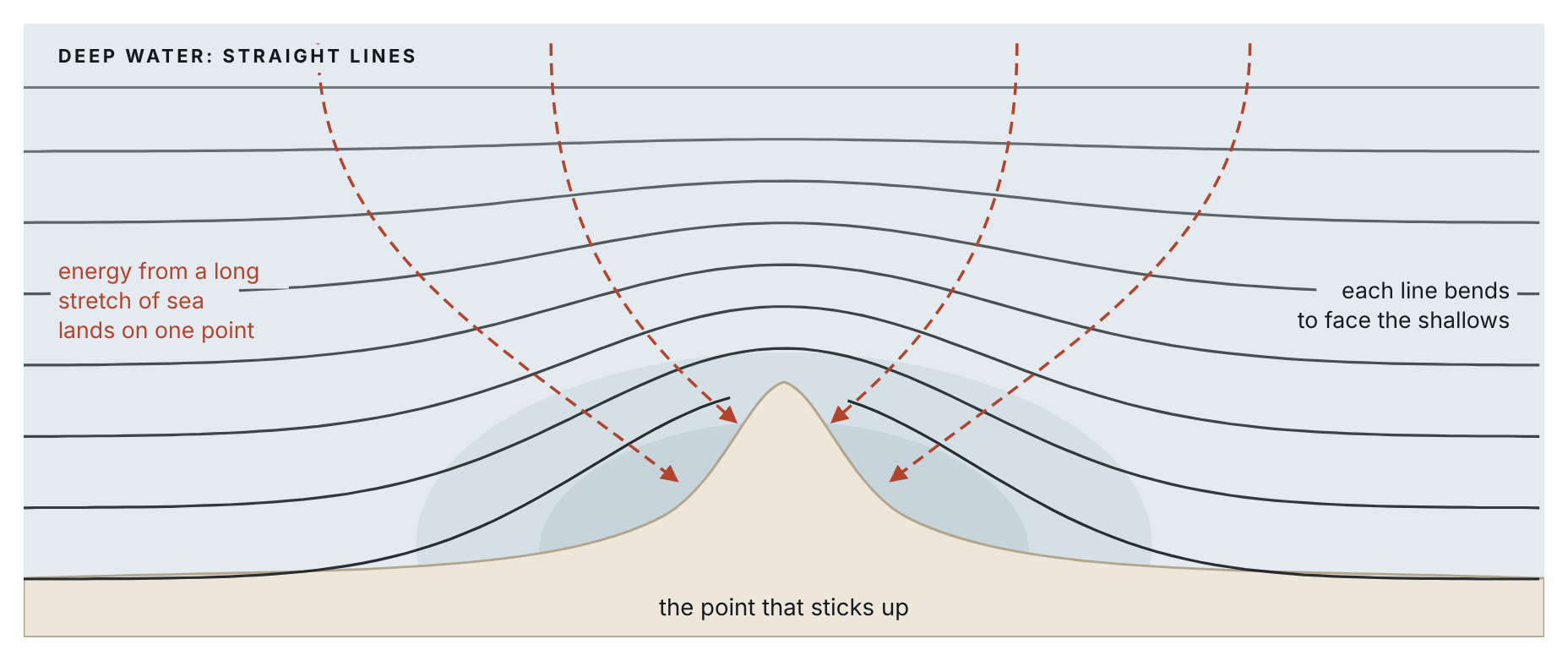
Picture 4. Refraction, seen from above. Crests bend to face the shallows, so the wave energy (dashed) converges on the headland.
People circle what hurts in the exact same geometry. A conversation begins somewhere safe, with work, or sleep, or a sibling, and every line of it bends back toward the same unmentioned reef.
In 2000, a JAMA study taped 116 routine medical visits and counted the indirect hints patients dropped about what was actually weighing on them. Hints surfaced in roughly half the visits. Physicians caught them 21 percent of the time in primary care and 38 percent of the time in surgery. When a hint was missed, the patient tended to circle back and drop it again, and the visits with missed hints ran longer than the ones where the doctor simply turned toward the reef.
The thing a person keeps returning to is the headland. It is often not the subject they spend the most words on.
Picture five: The calm strip is where the water is running out.
Look at a surf beach and find the gap. White water breaks left and right, and right between them sits a lane of darker, flat, inviting water. To an untrained eye, it looks like the safest place to swim. It is a rip current. That lane looks calm only because the channel underneath is deeper, so nothing breaks there, and the water pushed onto the beach is rushing straight back out to sea through that narrow throat.
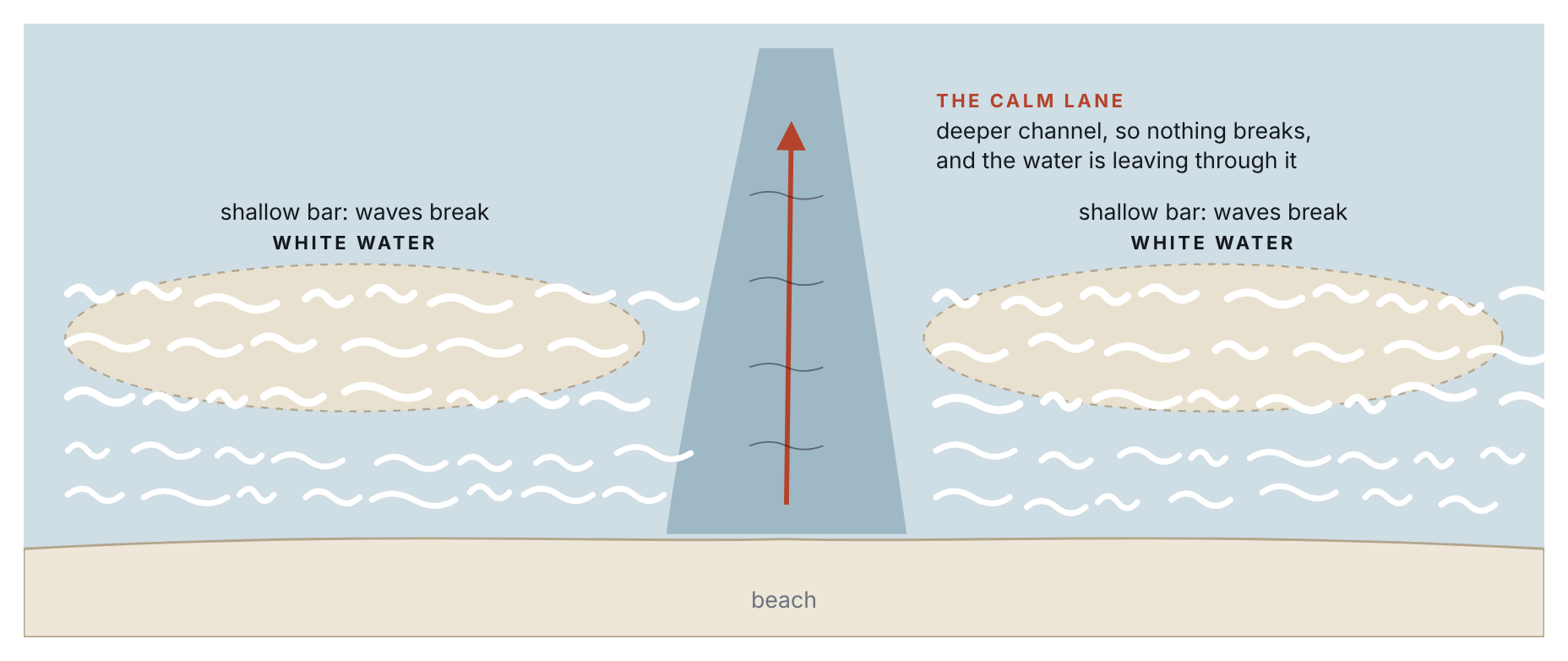
Picture 5. A rip current from above. The quiet lane between the breakers is the deep channel carrying the water back out.
Calm on the surface means one of two things: there is nothing underneath, or something deep is moving fast. From the sand, they look identical.
When a rough, jagged story suddenly goes smooth for one sentence, do not breathe a sigh of relief. One tidy, rehearsed line dropped into the middle of a difficult account is a flat lane. Lifeguards never trust the quiet water. They watch it twice as hard.
Picture six: The biggest wave in the ocean is the flattest.
Out in deep water, a tsunami is often less than a meter high. It is also hundreds of kilometers long and moving at the speed of a jet. A ship can pass right over it and the crew will not spill their coffee. That same wave can stand thirty feet tall when it runs out of deep water at the coast.
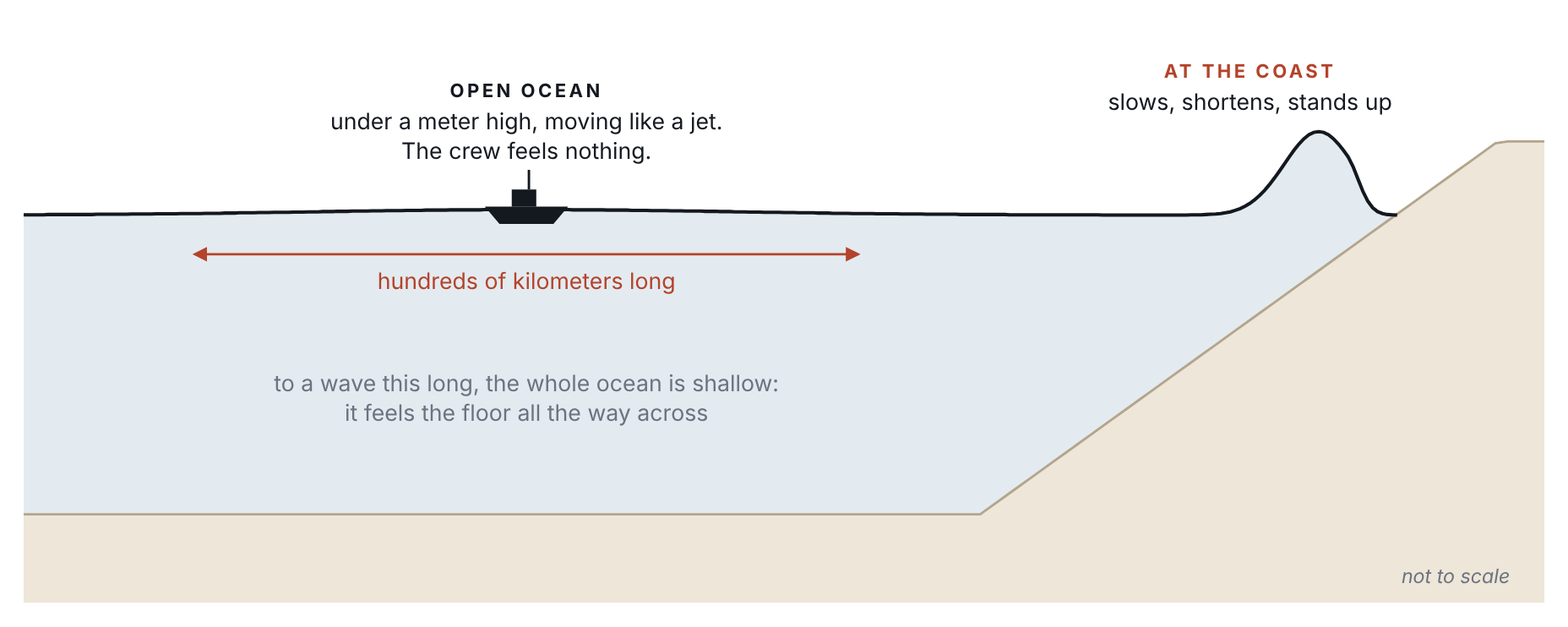
Picture 6. A tsunami crossing deep water is almost invisible. It rises only where the floor comes up to meet it.
Two truths sit inside that physics.
First, about the speaker: the heaviest thing a person carries often crosses the open water of a conversation disguised as “I’m fine.” Low. Long. Easy to sail right over without feeling a bump. How much weight a thing carries underneath and how tall it stands on the surface are two completely different measurements until the floor rises.
Second, about patience: a tsunami is so long that the entire ocean counts as shallow water to it. It drags against the floor all the way across. Conversation obeys the same law. Let a human exchange run long enough without cutting it off, and nothing the speaker carries stays out of reach. A listener who stays for the full run of the wave touches ground that no rapid-fire interrogation will ever find.
Picture seven: Waves laugh when they reach the shore.
The Greeks heard it before anyone measured it. Aeschylus wrote of the countless laughter of the sea waves, and ancient Greek used the language of laughter for what water does when it finally reaches the shallows and breaks.
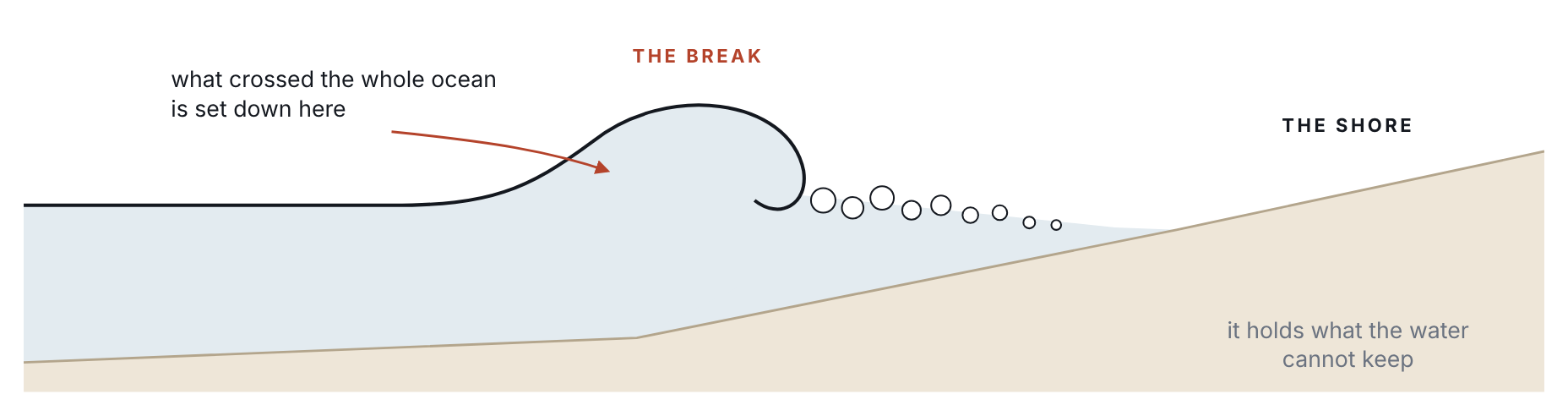
Picture 7. A wave ends by breaking. Everything it carried across the ocean is set down on the shore.
They understood human beings. Conversation researchers have spent decades studying the laugh that appears right in the middle of bad news. In 1984, Gail Jefferson showed that the person telling a hard truth often laughs, and the disciplined listener does not laugh along. Markku Haakana found the same pattern in medical clinics: patients laugh at the delicate points, and roughly 70 percent of the time, the physician does not join in. A lone laugh inside a heavy story is surf. It marks the exact spot where something buried just scraped the sand.
Breaking is also how a wave puts down its load. In 1997, Dacher Keltner and George Bonanno filmed people speaking about a spouse they had lost. The ones who laughed genuinely while telling the story carried less distress and recovered faster.
My mother used to say one line when life cornered us: you just have to laugh. The ocean backs her up. A wave that reaches a shore gets to break. A wave with no shore has to keep carrying its weight in the dark.
That makes the listener the shore. I wrote the line long before I ever looked at a wave chart:
“Patience is only the shore agreeing to hold what the water cannot keep.”
— t r a b o c c o
Reading the chart
At Duck, on the Outer Banks of North Carolina, the Army Corps of Engineers runs a research pier with cameras mounted on a tower. Those cameras never see beneath the surface. They film the top of the water, track how fast the crests move, and calculate the depth underneath to within half a meter. They map the invisible floor strictly by watching the skin of the sea.
You can read a conversation the exact same way.
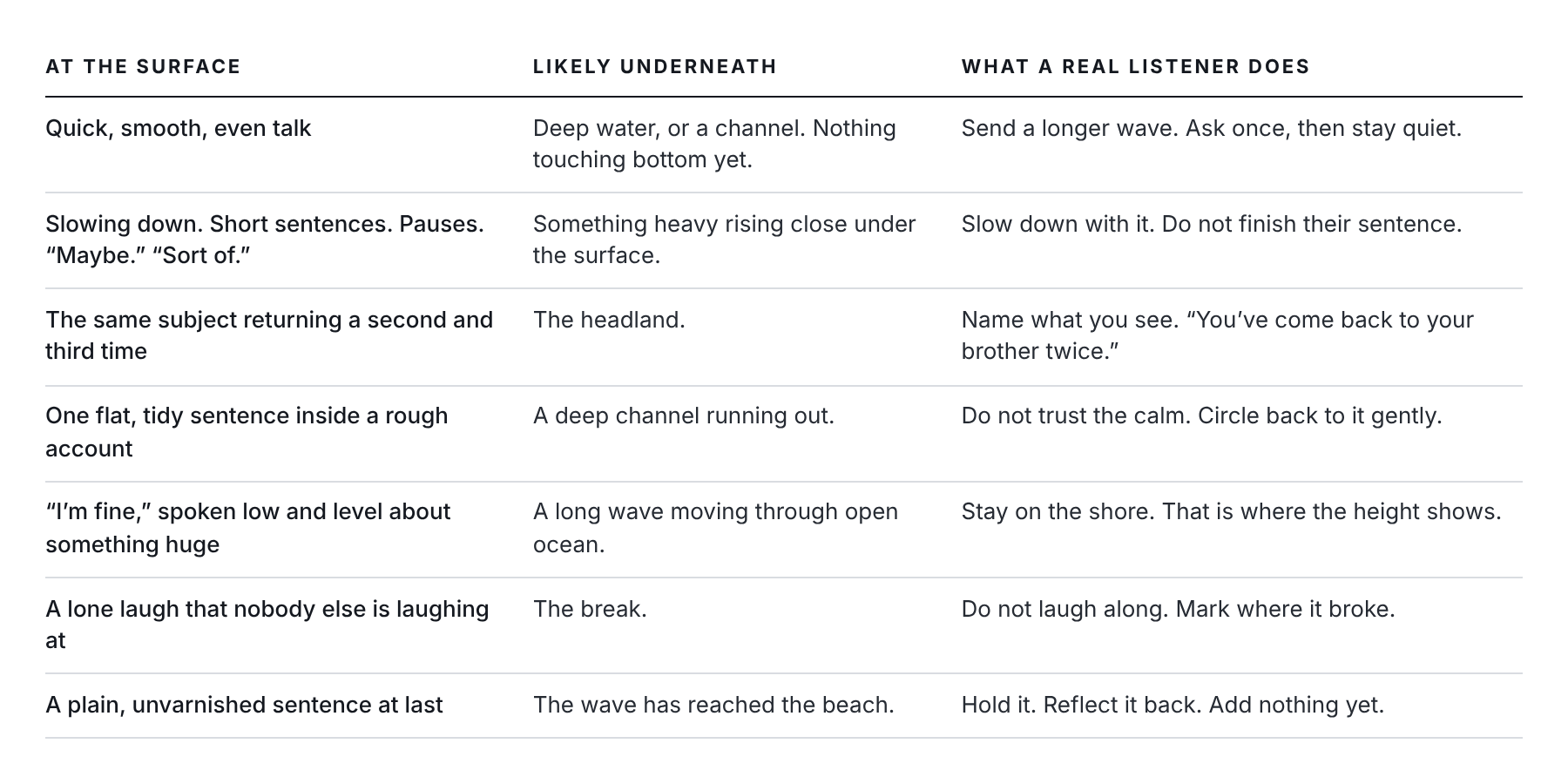
What this exposes about machines
Three failures in AI listening show up in these seven pictures.
All chop. Many benchmarks test a model on one prompt and one reply. That is a single short wave. Stacking ten thousand single-turn benchmarks on top of each other reaches no deeper than one.
A 2026 Oxford study put a number on it. Researchers gave six AI models the same five signs of distress, either in one message or spread across a 21-turn conversation. Spread out, four of the six gave the response experienced support workers expect in only 3 to 6 percent of conversations.
Oil on the water. Benjamin Franklin once poured a teaspoon of oil onto a pond in London and watched the ripples flatten across half an acre. When an AI system rushes to soothe, summarize, and staple a safety disclaimer onto its first reply, it is pouring oil on the water. The surface goes dead flat, and a flat surface cannot be read. I named this failure Premature Containment, and the remedy reverses the machine’s instinct: recognize, stabilize, articulate, test. Watch the waves first. Steady the boat. Name what is actually there. Only then drop the line.
Yesterday’s surf. Sandbars shift. Steering by last week’s bathymetry chart will put your hull on the rocks tonight. A stored transcript or a memory log is just a seashell on a shelf: it holds the echo of the ocean long after it has left the tide. Memory is not coherence. Coherence means holding and reflecting what actually matters in a live exchange without losing it, distorting it, inventing over it, or closing the door early. Keep watching the water. Do not flatten it. Do not paint waves onto it that were never there.
Where the analogy ends
A sea floor does not rearrange itself because someone is watching it. A human being does. People edit themselves for the person sitting across from them. A pause can mean grief, or exhaustion, or simple courtesy. Every sign on that chart is an invitation to pay closer attention, never an excuse to play mind-reader.
And safety always outranks stillness. Nothing here says to sit quietly while a person is in immediate danger. If someone is at risk right now, you ask plainly and you act; the long conversation comes after the storm passes. The warning against pouring oil on the water is aimed at polite automation used to get rid of a person, never at genuine rescue.
And chop has its place. Most of what we ask each other, and most of what we ask machines, is a quick question that deserves a quick answer. Nobody needs a long wave to find out when the train leaves. The failure is using chop on the one conversation that needed patience, and never noticing the difference.
What is solid, what is a bridge, and how to break it
What is solid: Every physical claim here about wave mechanics is textbook oceanography. Every clinical and linguistic study is real and cited below.
What is a bridge: Mapping ocean waves onto human speech is an analogy, and analogies are cheap unless they risk being proven wrong. This one earns its keep because it makes five testable claims that can fail under measurement:
- In the turns immediately preceding a major disclosure, a speaker’s language measurably slows and shortens.
- Major disclosures occur at significantly higher rates following uninterrupted turns than after early redirection.
- The recurring subject a speaker circles back to predicts the eventual disclosure more reliably than the topic given the highest word count.
- Unshared, lone laughter precedes delicate disclosure more often than mutual laughter.
- The smoothest, briefest line inside an otherwise fragmented account marks a high-probability site of unstated weight.
If hesitation, recurrence, and lone laughter predict nothing better than a coin flip, or if eleven-second exchanges uncover the exact same truths as unhurried ones, throw the chart away.
The last place left that runs long
Almost everything we build now is engineered to cut the wave short. The eleven-second clinic opening. The intake form with little boxes. The rapid-fire text thread. The instant AI summary. Every one of them is built for chop, and none of them touches the floor.
One ancient piece of technology still runs the other way.
The dinner table.
People gather around and sit facing each other. Nobody checks the clock for an hour or two. The talk wanders, doubles back, stalls out, someone laughs at the wrong moment, and eventually a plain, unadorned sentence lands on the table that nobody could have dragged out with a direct question.
My mother always said the dinner table is where all wars should begin and end. Read through the physics of the sea, she was talking about the longest wave most families will ever get to ride.
Not all questions reach the bottom. Pull up a chair.
— t r a b o c c o
Sources & notes
- Wave orbits, wave base, and shoaling: P. Webb, Introduction to Oceanography, section 10.1; D. Segar, Introduction to Ocean Sciences, section 9.8 (refraction).
- Rip currents: U.S. National Weather Service, Rip Current Science; NOAA, rip current overview.
- Tsunamis in deep water: NOAA, U.S. Tsunami Warning System; NOAA JetStream, tsunami propagation.
- Bathymetry from surface wave video at Duck, NC: Holman, Plant, and Holland (2013), “cBathy: a robust algorithm for estimating nearshore bathymetry,” J. Geophys. Res. Oceans 118.
- Time before clinical redirection: Beckman and Frankel (1984), Ann. Intern. Med. 101; Marvel et al. (1999), JAMA 281; Singh Ospina et al. (2018), J. Gen. Intern. Med.; Dyche and Swiderski (2005), J. Gen. Intern. Med.
- Uninterrupted patient talking time: Langewitz et al. (2002), BMJ 325:682.
- Patient hints and missed clinical opportunities: Levinson, Gorawara-Bhat, and Lamb (2000), JAMA 284:1021.
- Laughter in troubles-telling: Jefferson (1984), in Structures of Social Action, Cambridge University Press; Haakana (2001), Text 21:187, and Haakana (2002), J. Sociolinguistics 6.
- Laughter in bereavement: Keltner and Bonanno (1997), J. Pers. Soc. Psychol. 73:687.
- Greek waves and laughter: “Laughing Waves in Ancient Greek,” University of Chicago Press journals; Aeschylus, Prometheus Bound, lines 88 to 90.
- Oil on water: Benjamin Franklin, letter to William Brownrigg, 7 November 1773 (the Clapham Common pond).
- Pauses in unscripted speech: Goldman-Eisler (1958), “Speech Production and the Predictability of Words in Context,” Quarterly Journal of Experimental Psychology 10:96; Shriberg and Stolcke (1996), “Word Predictability After Hesitations.”
- AI and gradual disclosure: Peart, Hafner, and Rocher (2026), “Evaluating safeguarding in multi-turn conversations with AI assistants,” Oxford Internet Institute, arXiv:2611.26009 (preprint).
- Coherence and Signal Literature: Joe Trabocco, “The Afternoon Is Gone”; “Premature Containment in Human-AI Interaction” (2026); Signal Literature clinical coherence framework and weight-loss case study.
“Countless laughter” is the author’s rendering of the Greek; published translations give “infinite,” “multitudinous” or “numberless.” Prometheus Bound is traditionally attributed to Aeschylus, and some scholars doubt the attribution. The surfer and the sixty-foot wreck are illustrations. The mapping from water to people is an analogy and has not been tested.